Rating
PROFive steps from Poor to Great, with reasons when low
Hover or slide to preview, click to pick; 1-5, ← →, Backspace clears
Variants
Look
pnpm dlx shadcn@latest add @notchset-pro/ratingPair this component with
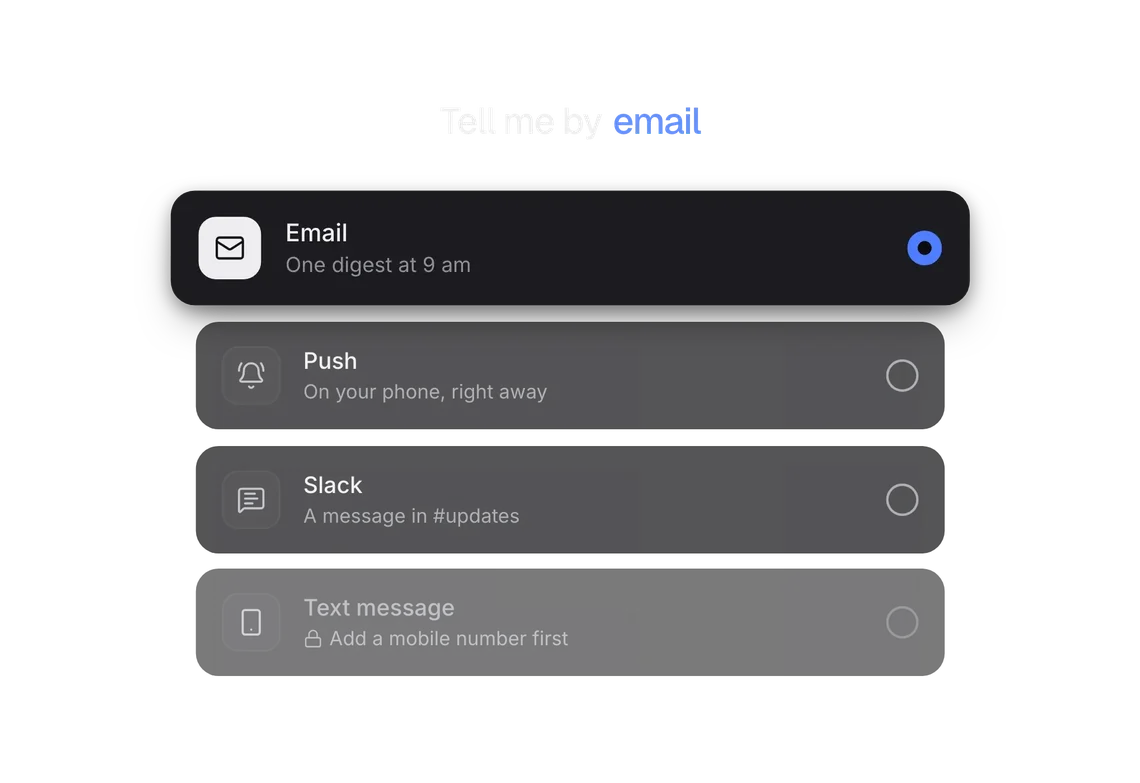
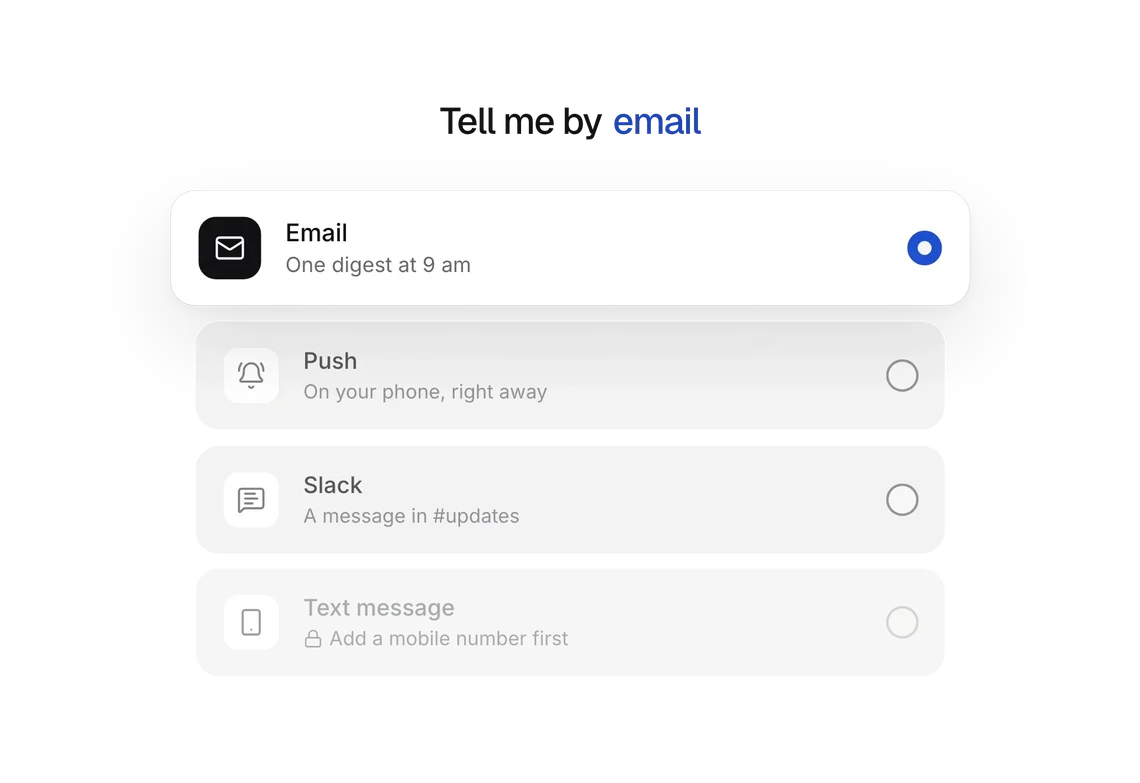
A score from one to five, said in a word, that asks why when it is low.
Every shadcn style · one file
Usage
Import it and pass your content. The props that matter most are listed next.
Example · as previewed
"use client";
import * as React from "react";
import { useLessMotion } from "@/lib/notchset/motion";
import { Rating } from "@/components/ui/notchset/rating";
import { useSelfPlay } from "./self-play";

/*
 * Rate something, alone. The showpiece: large stars; on view the fill sweeps out to three, back to two, out to five,
 * and five is picked: the stars pop in turn, the fifth throws its burst, the row hops in a wave, "Loved it" lands. The
 * plain stars pick four once. Steps, the handy alternative: one is picked and grows into a large numeral, four rolls
 * it, and Send stamps "Thanks" as the steps hop in a wave. Then the hand: hover or
 * slide along to preview, click or lift to pick, 1-5, the arrows, Backspace to clear. With the knob on, the next save is
 * refused: the fill drains away and the words say so.
 */
type Look = "show" | "plain" | "steps";
const WORDS = { ask: "How was it?" };
const SWEEP = [1, 2, 3, 2, 3, 4, 5];

function hoverAt(root: Element | null, n: number) {
  const el = root?.querySelectorAll<HTMLElement>("[role=radio]")[n - 1];
  if (!el) return;
  const r = el.getBoundingClientRect();
  el.dispatchEvent(new PointerEvent("pointermove", { bubbles: true, clientX: r.left + r.width / 2, clientY: r.top + r.height / 2, pointerType: "mouse" }));
}

export default function RatingDemo() {
  const look = "show" as Look;
  return <Stage key={look} look={look} />;
}

function Stage({ look }: { look: Look }) {
  const fails = false;
  const words = WORDS;
  const less = useLessMotion();
  const root = React.useRef<HTMLDivElement>(null);
  const [value, setValue] = React.useState(0);
  const [failedAt, setFailedAt] = React.useState<number>();
  const beats = look === "show" ? [240, 240, 240, 400, 380, 220, 220, 460, 600] : look === "steps" ? [380, 700, 900] : [650];
  const self = useSelfPlay(root, { beats, off: less });
  React.useEffect(() => {
    if (self.mine || self.step < 0) return;
    const el = root.current;
    if (look === "steps") {
      if (self.step === 2) return void el?.querySelector<HTMLButtonElement>("[data-readout] button:not([role])")?.click();
      return void el?.querySelectorAll<HTMLElement>("[role=radio]")[self.step === 0 ? 0 : 3]?.click();
    }
    if (look !== "show") return void el?.querySelectorAll<HTMLElement>("[role=radio]")[3]?.click();
    if (self.step < SWEEP.length) return hoverAt(el, SWEEP[self.step]!);
    if (self.step === SWEEP.length) return void el?.querySelectorAll<HTMLElement>("[role=radio]")[4]?.click();
    el?.querySelector("[role=radiogroup]")?.dispatchEvent(new PointerEvent("pointerleave", { pointerType: "mouse" }));
  }, [self.step, self.mine, look]);
  const save = (n: number) => {
    setValue(n);
    if (!fails || !n) return;
    /* the save is refused once the pops have played: the score goes back and the fill drains */
    window.setTimeout(() => {
      setValue(0);
      setFailedAt(Date.now());
    }, 620);
  };
  return (
    <div ref={root} onPointerDownCapture={self.handOver} onKeyDownCapture={self.handOver} className="flex w-full flex-col items-center gap-6">
      {look === "steps" ? (
        <Rating kind="scale" readout label={words.ask} value={value} onValueChange={setValue} onSend={() => !fails} asksBelow={0} className="w-[min(100%,300px)]" />
      ) : (
        <>
          <p className="m-0 text-[length:var(--ns-text-sub)] font-[number:var(--ns-weight-medium)] text-[var(--ns-ink-2)]">{words.ask}</p>
          <div className="max-w-full">
            <Rating kind="stars" look={look} label={words.ask} value={value} onValueChange={save} failedAt={failedAt} />
          </div>
        </>
      )}
    </div>
  );
}Example: the full example
Example
"use client";
import * as React from "react";
import { useLessMotion } from "@/lib/notchset/motion";
import { Rating } from "@/components/ui/notchset/rating";
import { useSelfPlay } from "./self-play";

/*
 * Rate something, alone. The showpiece: large stars; on view the fill sweeps out to three, back to two, out to five,
 * and five is picked: the stars pop in turn, the fifth throws its burst, the row hops in a wave, "Loved it" lands. The
 * plain stars pick four once. Steps, the handy alternative: one is picked and grows into a large numeral, four rolls
 * it, and Send stamps "Thanks" as the steps hop in a wave. Then the hand: hover or
 * slide along to preview, click or lift to pick, 1-5, the arrows, Backspace to clear. With the knob on, the next save is
 * refused: the fill drains away and the words say so.
 */
type Look = "show" | "plain" | "steps";
const WORDS = { ask: "How was it?" };
const SWEEP = [1, 2, 3, 2, 3, 4, 5];

function hoverAt(root: Element | null, n: number) {
  const el = root?.querySelectorAll<HTMLElement>("[role=radio]")[n - 1];
  if (!el) return;
  const r = el.getBoundingClientRect();
  el.dispatchEvent(new PointerEvent("pointermove", { bubbles: true, clientX: r.left + r.width / 2, clientY: r.top + r.height / 2, pointerType: "mouse" }));
}

export default function RatingDemo() {
  const look = "show" as Look;
  return <Stage key={look} look={look} />;
}

function Stage({ look }: { look: Look }) {
  const fails = false;
  const words = WORDS;
  const less = useLessMotion();
  const root = React.useRef<HTMLDivElement>(null);
  const [value, setValue] = React.useState(0);
  const [failedAt, setFailedAt] = React.useState<number>();
  const beats = look === "show" ? [240, 240, 240, 400, 380, 220, 220, 460, 600] : look === "steps" ? [380, 700, 900] : [650];
  const self = useSelfPlay(root, { beats, off: less });
  React.useEffect(() => {
    if (self.mine || self.step < 0) return;
    const el = root.current;
    if (look === "steps") {
      if (self.step === 2) return void el?.querySelector<HTMLButtonElement>("[data-readout] button:not([role])")?.click();
      return void el?.querySelectorAll<HTMLElement>("[role=radio]")[self.step === 0 ? 0 : 3]?.click();
    }
    if (look !== "show") return void el?.querySelectorAll<HTMLElement>("[role=radio]")[3]?.click();
    if (self.step < SWEEP.length) return hoverAt(el, SWEEP[self.step]!);
    if (self.step === SWEEP.length) return void el?.querySelectorAll<HTMLElement>("[role=radio]")[4]?.click();
    el?.querySelector("[role=radiogroup]")?.dispatchEvent(new PointerEvent("pointerleave", { pointerType: "mouse" }));
  }, [self.step, self.mine, look]);
  const save = (n: number) => {
    setValue(n);
    if (!fails || !n) return;
    /* the save is refused once the pops have played: the score goes back and the fill drains */
    window.setTimeout(() => {
      setValue(0);
      setFailedAt(Date.now());
    }, 620);
  };
  return (
    <div ref={root} onPointerDownCapture={self.handOver} onKeyDownCapture={self.handOver} className="flex w-full flex-col items-center gap-6">
      {look === "steps" ? (
        <Rating kind="scale" readout label={words.ask} value={value} onValueChange={setValue} onSend={() => !fails} asksBelow={0} className="w-[min(100%,300px)]" />
      ) : (
        <>
          <p className="m-0 text-[length:var(--ns-text-sub)] font-[number:var(--ns-weight-medium)] text-[var(--ns-ink-2)]">{words.ask}</p>
          <div className="max-w-full">
            <Rating kind="stars" look={look} label={words.ask} value={value} onValueChange={save} failedAt={failedAt} />
          </div>
        </>
      )}
    </div>
  );
}
self-play.ts: the sample data the example imports, saved beside it
self-play.ts
"use client";
import * as React from "react";

/*
 * A demo that plays itself until the first touch: the script lives in the demo, never in the piece, which only gets
 * the props a person would give it. It moves 0.4 s after the piece is first seen, then takes each step on its beat;
 * off screen or paused it waits. The first press, key or focus on the piece (bind `handOver` to it; a scroll over it never counts) makes it the
 * visitor's for good and drops every queued step; with less motion (`off`) it never plays and rests in its first frame.
 * A host can hand it over from outside the piece too (a settings panel beside it the visitor has used): under
 * <HandedOver value>, it never plays, a remount included.
 *
 *   const play = useSelfPlay(root, { beats: [2800, 2800], loop: true, off: less });
 *   <div ref={root} onPointerDownCapture={play.handOver} onKeyDownCapture={play.handOver} onFocusCapture={play.handOver}>
 *   play.step // the step it is at, -1 before its first
 *   play.control // "pause" while it plays, "play" once paused (a new take), "replay" once it is over or yours
 *
 * Each step presses the piece's own controls (pressIn), so the script shows exactly what a hand can do.
 *
 * A host that shows the piece once (<PlayOnce value={{ settle }}>) changes three things: the script starts when the
 * piece is first half in view and never again on coming back, it never loops, and with less motion (or `settle`) it
 * takes every step at once, so the piece rests on the END of its moment. `hold` is a reason not to play at all that is
 * not motion (a mode with nothing to show): it holds in every host. Under <PlayOnce value={{ active: false }}> (a look
 * that is mounted but not shown) it waits until it is shown.
 */
type SelfPlayOptions = {
  /** how long each step waits after the one before it, in ms; the first step waits 0.4 s after the piece is seen */
  beats: readonly number[];
  /** starts over after the last step; without it the script plays once and rests */
  loop?: boolean | undefined;
  /** no self-play at all (less motion): the piece is the visitor's from the start */
  off: boolean;
  /** no self-play for a reason other than motion (a mode with nothing to show), in every host */
  hold?: boolean | undefined;
};

/** How a host shows the piece: once on arrival (see useSelfPlay). */
type PlayOnceHost = {
  /** rest on the end at once, without playing (less motion, or a reset) */
  settle?: boolean | undefined;
  /** false while the piece is mounted but not shown: it waits */
  active?: boolean | undefined;
};

const START = 400;
/**
 * Whether a demo plays itself at all. Off: every piece rests in its first frame and is
 * the visitor's from the start; nothing presses its controls for them.
 */
const SELF_PLAY: boolean = false;

/** True where the visitor has already taken the piece from outside it: nothing under it plays itself. */
const HandedOver = React.createContext(false);

/** A host that shows the piece once: play once on arrival, rest on the end (null: play as the demo asks). */
const PlayOnce = React.createContext<PlayOnceHost | null>(null);

function useSelfPlay(root: React.RefObject<Element | null>, { beats, loop: looped = false, off: still, hold = false }: SelfPlayOptions) {
  const once = React.useContext(PlayOnce);
  const active = once?.active !== false;
  /* shown once: less motion (or a settled host) takes every step at once and rests on the end */
  const quick = once != null && (still || Boolean(once.settle));
  const loop = once == null && looped;
  /* the first touch hands it over for good */
  const [mine, setMine] = React.useState(false);
  const handOver = React.useCallback(() => setMine(true), []);
  const handedOver = React.useContext(HandedOver);
  const off = !SELF_PLAY || hold || (quick ? false : still) || mine || (handedOver && !quick);
  const [seen, setSeen] = React.useState(false);
  const [paused, setPaused] = React.useState(false);
  const [taken, setTaken] = React.useState(0);
  const n = Math.max(1, beats.length);
  const done = !loop && taken >= n;
  React.useEffect(() => {
    const el = root.current;
    if (!active) return;
    /* without an observer (an old browser, a test) it counts as seen */
    if (!el || typeof IntersectionObserver === "undefined" || quick) {
      const t = window.setTimeout(() => setSeen(true));
      return () => window.clearTimeout(t);
    }
    /* shown once: first half in view starts it, and leaving never stops or restarts it */
    const io = once
      ? new IntersectionObserver((es) => {
          if (es.some((e) => e.isIntersecting && e.intersectionRatio >= 0.5)) {
            setSeen(true);
            io.disconnect();
          }
        }, { threshold: 0.5 })
      : new IntersectionObserver((es) => setSeen(es.some((e) => e.isIntersecting)));
    io.observe(el);
    return () => io.disconnect();
  }, [root, active, once, quick]);
  const playing = !off && seen && active && !paused && !done;
  const delay = quick ? 0 : taken === 0 ? START : (beats[taken % n] ?? START);
  React.useEffect(() => {
    if (!playing) return;
    const t = window.setTimeout(() => setTaken((k) => k + 1), delay);
    return () => window.clearTimeout(t);
  }, [playing, taken, delay]);
  /* one control in one place: Pause while it plays, Play (a new take) once paused, Replay once it is over or yours */
  /* self-play off: never "over", so a demo rests in its FIRST frame, not its end frame */
  const control: "pause" | "play" | "replay" = paused || !SELF_PLAY ? "play" : off || done ? "replay" : "pause";
  return { step: taken === 0 ? -1 : (taken - 1) % n, taken, playing, control, mine, handOver, pause: () => setPaused(true) };
}

/**
 * Presses a real control inside `root`, as the visitor would: the first match of `selector`, or the one whose text is
 * `text`. A click only, so it never counts as the visitor's touch.
 */
function pressIn(root: Element | null, selector: string, text?: string) {
  const all = [...(root?.querySelectorAll<HTMLElement>(selector) ?? [])];
  (text == null ? all[0] : all.find((el) => el.textContent?.trim() === text))?.click();
}

export { HandedOver, PlayOnce, pressIn, useSelfPlay, type PlayOnceHost, type SelfPlayOptions };
Anatomy
Built fromRating with reasons
Source
components/ui/notchset/rating.tsx
This component is included with Pro.
Try the live preview above. Get Pro to install the source.
LevelOrganism: made of molecules or blocks.
Made ofRating with reasons
Install notes
Needs your registry key. Every components.json style gets the same files.
Works with React 18.3 or 19 on Tailwind CSS v4, in any shadcn project. What's tested
Styles didn't apply?
The CLI adds the styles to the CSS file named in components.json (tailwind.css). Check that it points at your global stylesheet, that the project uses Tailwind CSS v4, and that the file is imported in your root layout. Installed by hand: paste styles.css into that file.
Props
Three usesrating a call that just ended · scoring an assistant's answer · how hard a workout felt
- words
- five words, one each, Poor to Great
- reasons
- about four reasons, 1 to 3 words each: "Too slow"
For coding agents
Give your coding assistant the Markdown guide instead of screenshots.
Use it for
- Scoring one thing from one to five where a word helps (a call, an answer, an effort).
Use something else when
- Rating a generated reply up or down, with its reasons, is rating-reasons (kind thumbs).
Mistakes to avoid
- Half steps: a score is a whole word
- Asking why on a good score: only a low one asks
- Stars in amber beside the Signature: the run is one colour
Keyboard and screen readers
- A named radiogroup of five radios, each named "Good, 4 of 5", with one tab stop.
- Read-only is one image named by its score.
- The reasons are a named group; the thanks a status.
Motion
- the chosen run fills left to right: clip-path on --ns-time-panel, --ns-ease-move, 40ms apart. Reduced motion: filled at once.
- the last step pops: ns-pop on --ns-time-spring, --ns-ease-pop. Reduced motion: none.
- the word lands: ns-rise (data-ns-rise). Reduced motion: a fade.
Responsive
- phone: large steps, scrubbed by a finger
- desktop
- dark (tokens)
- reduced motion: the run is there at once
Performance
- Five buttons and a few spans; no dependencies beyond Button.
Where agents read it
- Guide for this component: https://notchset.dev/md/rating.md
- Every component, for tools without MCP: /llms.txt
- MCP server:
https://notchset.dev/api/mcp(setup)
Part of
Included with Pro
One payment, lifetime.
Pair this component with
Changelog
v2.0.0 · 2026-10-13
Released with the Notchset system.